

Ten golden statues of women, standing along rue de la Chapelle in front of the Adidas Arena – one of Paris’s most striking open-air monuments. Born from the Paris 2024 Olympic Games, these gilded sculptures honor ten women who shaped French history. Free to visit, permanent, and two minutes from the metro. Here’s everything you need to know before you go.

Visiting in September 2026? The City of Paris runs a free guided tour of the statues on Saturday 19 September, 11am–12pm, as part of the European Heritage Days. Registration opens online in early September, in French, through paris.fr. The meeting point is confirmed at registration.
Where do the golden women statues come from?
These ten sculptures were created for the opening ceremony of the Paris 2024 Olympic Games on 26 July 2024. They rose from the Seine at the foot of the Pont Alexandre III during an extraordinary artistic sequence called Sororité (Sisterhood), directed by Thomas Jolly – as Axelle Saint-Cirel sang La Marseillaise from the rooftop of the Grand Palais. Hundreds of millions of viewers around the world watched.
After the Games, Paris Mayor Anne Hidalgo chose to make them permanent. The statues were first displayed at the French National Assembly, then installed for good on rue de la Chapelle (18th arrondissement) in the summer of 2025, one year after the Olympics. The location is deliberate: Porte de la Chapelle is the neighborhood most transformed by the Olympic legacy.
📍 Location: Rue de la Chapelle, 75018 Paris – pedestrian promenade facing the Adidas Arena
Access: Free, open 24/7, no ticket or booking required
Getting there: Metro line 12 (Porte de la Chapelle) or Tram T3b (Colette Besson) – 2-minute walk
Who are the 10 women honored by the golden statues?
Each statue represents a French woman who left a lasting mark on history – in politics, sport, literature, cinema, exploration or activism. Many of their names are barely known outside France. That’s precisely the point. Here is every one of them.
Olympe de Gouges (1748–1793)
Playwright and political activist who wrote the Declaration of the Rights of Woman and the Female Citizen (1791) – a direct, radical response to the Declaration of the Rights of Man. She was guillotined during the Reign of Terror.
Alice Milliat (1884–1957)
French swimmer, field hockey player and rower. When the IOC refused to include women in the Olympics, she founded the first Women’s Olympic Games in Paris in 1922. The world’s first female sports leader – and largely forgotten until recently.
Simone Veil (1927–2017)
Holocaust survivor, magistrate and politician. As France’s Minister of Health, she steered the landmark 1975 abortion rights law through parliament against fierce opposition. President of the European Parliament (1979–1982). Inducted into the Panthéon in 2018.
Gisèle Halimi (1927–2020)
Tunisian-French lawyer, activist and politician. Famous for her courtroom battles against torture in Algeria and for abortion rights. Co-founder of Choisir la cause des femmes (Choose the Cause of Women).
Simone de Beauvoir (1908–1986)
Philosopher and novelist, author of The Second Sex (1949) – one of the foundational texts of modern feminism. A central figure of existentialism and lifelong partner of Jean-Paul Sartre.
Paulette Nardal (1896–1985)
Martinican intellectual, journalist and writer. The first Black woman to study at the Sorbonne. Co-founder of the Négritude movement alongside Aimé Césaire and Léopold Sédar Senghor – a major literary and political movement celebrating Black African culture.
Jeanne Barret (1740–1807)
Explorer and botanist. The first woman to circumnavigate the globe – disguised as a man to board Bougainville’s ship in 1766, since women were forbidden from such expeditions. Her story was suppressed for nearly two centuries.
Louise Michel (1830–1905)
Teacher, writer, anarchist and feminist. Known as « The Red Virgin of Montmartre, » she was a key figure of the Paris Commune (1871) and was deported to New Caledonia for her role in the uprising.
Christine de Pizan (1364–1431)
Italian-born French poet and author – the first woman in Europe known to have earned a living by writing. Her Book of the City of Ladies (1405) is considered a proto-feminist masterpiece, written six centuries before the feminist movement.
Alice Guy (1873–1968)
The world’s first female film director. She made her first film at Gaumont in 1896 – the same year as the Lumière brothers’ first screenings. A true pioneer, her contribution was ignored for decades before being fully recognized.

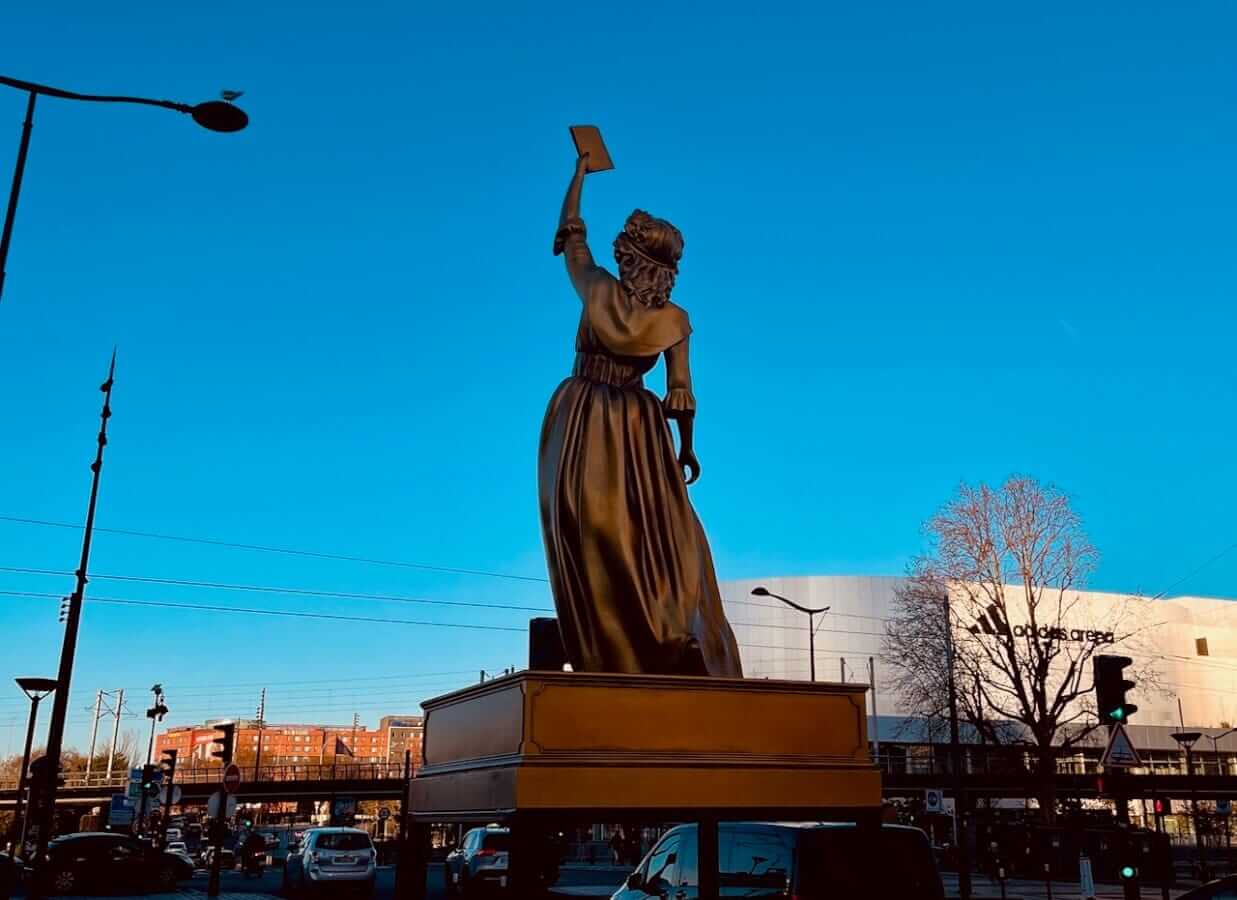
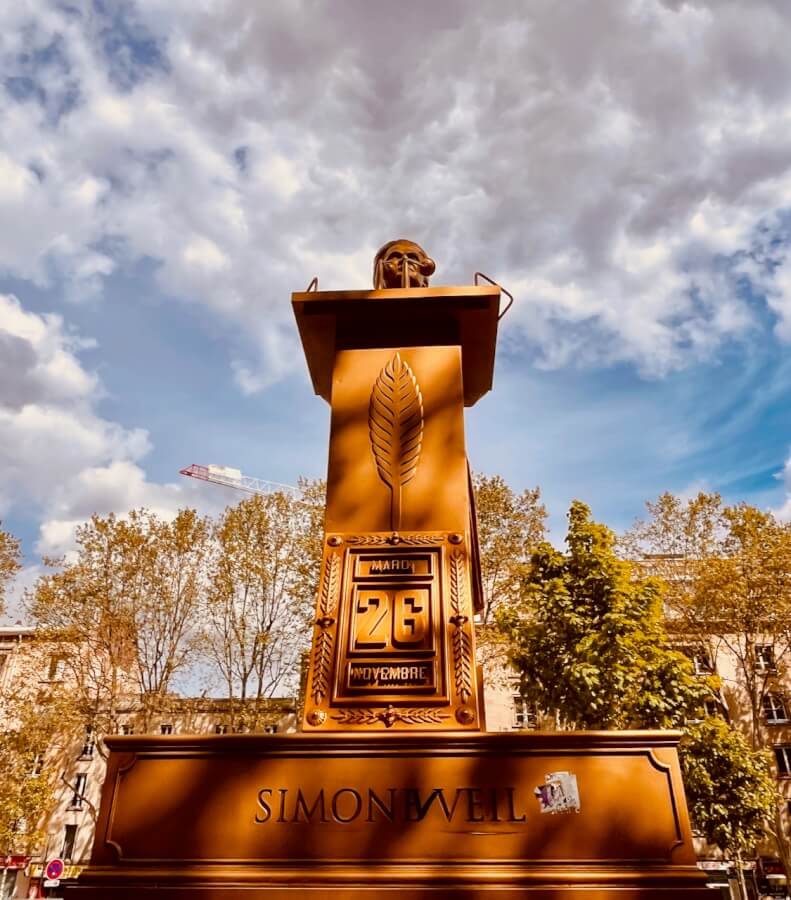
How to visit the golden women statues
The visit is completely free – no ticket, no booking, no guided tour required. The ten sculptures are spread along the pedestrian promenade of rue de la Chapelle, from the Porte de la Chapelle junction down to the entrance of the Adidas Arena. Allow 20 to 30 minutes for the full walk, reading the explanatory panels at the foot of each statue.
Best time to visit
Late afternoon, between 4pm and 6pm depending on the season. The low-angle light hits the gilded bronze beautifully – the statues almost glow. Avoid event nights at the Adidas Arena: the promenade gets crowded with concert or match crowds and security perimeters can reduce access.
Visiting with children
The route is fully flat and stroller- and wheelchair-accessible. Each information panel is written clearly enough for children aged 8 and up. It makes for a genuinely engaging history lesson – these are not figures you’ll find in most school textbooks.


A neighborhood transformed – the Olympic legacy at Porte de la Chapelle
Before 2024, Porte de la Chapelle was better known for urban hardship than cultural landmarks. The Olympics accelerated a transformation already underway: the renovation of the Chapelle International hall, the construction of the Adidas Arena (8,000 seats), the expansion of Campus Condorcet, and a full redesign of public spaces.
Rue de la Chapelle is now a wide pedestrian promenade – with cycle lanes, greenery, new lighting and reduced car space, comparable to Paris’s main boulevards. The golden statues are at the heart of this transformation. They’re not decoration. They make a statement: a neighborhood that was overlooked now carries the names of women who changed the world.
This is already Paris.
Discover more about the neighborhood in our complete Porte de la Chapelle guide.
Frequently asked questions
Where exactly are the golden women statues in Paris?
The ten statues are installed on rue de la Chapelle, 75018 Paris, on the pedestrian promenade facing the main entrance of the Adidas Arena. They’re visible immediately from the exit of Metro line 12 (Porte de la Chapelle station) and from Tram T3b stop Colette Besson.
Who are the 10 women represented by the golden statues?
The ten women are: Olympe de Gouges, Alice Milliat, Simone Veil, Gisèle Halimi, Simone de Beauvoir, Paulette Nardal, Jeanne Barret, Louise Michel, Christine de Pizan and Alice Guy. Each made a lasting impact on French history across politics, sport, literature, cinema, exploration and activism.
Is the visit free?
Yes – completely free. No ticket, no booking, no opening hours. Rue de la Chapelle is a public space open 24 hours a day, 7 days a week.
When were the golden statues installed?
Created for the Paris 2024 Olympic Games opening ceremony on 26 July 2024, the statues were first displayed at the French National Assembly, then permanently installed on rue de la Chapelle in summer 2025, one year after the Games.
How do I get from the Adidas Arena to the statues?
The statues are less than 2 minutes on foot from the main entrance of the Adidas Arena – directly on rue de la Chapelle, right in front of the venue. You’ll walk past them on your way in or out.
Are the statues permanent or temporary?
Permanent. Paris Mayor Anne Hidalgo confirmed their definitive installation as part of the post-Olympic redevelopment of Porte de la Chapelle. They are not moving.
Can I visit the statues and the Adidas Arena on the same day?
Absolutely – it’s the natural combination. The statues sit right on the approach to the Arena. Walk the promenade first, then head inside for your event. Allow 30 minutes for the statues walk before doors open.
Coming to an event at the Adidas Arena?
–
Pratique - a lire aussi